We’ve previously offered our opinion about billionaire John Arnold’s efforts to insert his foundation’s opinions about public employee pensions into the public debate.
Our point has been simple – Arnold secured his retirement by the age of 39 with single-minded focus on investment trading while hard working men and women taught children, fought fires and busted bad guys for the general benefit of society. Their retirement may be later in their life than his, but they deserve the opportunity to have good investment management for their retirement nest egg, just as Arnold created for himself. Defined benefit plans offer that opportunity for people more concerned about the public good than their own trading account.
Over time we’ve also noticed that David and Charles Koch have become active participants in policy debates about public employees’ pensions. The Koch brothers’ financial support of the Cato Foundation, Americans for Prosperity, the Texas Public Policy Foundation, and the American Legislative Exchange Council are all documented fact by other sources, here and here as examples. (Other billionaires, like George Soros and Michael Bloomberg, are known to swing their money around as well for their pet causes, so we don’t want to seem lopsided in our concern about billionaire influence on U.S. politics.)
But we wanted to spend just a minute congratulating MSNBC TV host Rachel Maddow for her recent stand in support of general journalistic prerogative in investigating and recounting the activities of the Koch brothers and their billionaire power plays. You can see here her brave stand against the Koch brothers’ attempt to dissuade her investigation of their activities.
Just as TEXPERS has had to spend time and effort defending public employees’ pension benefits from billionaires’ schemes, we support all journalists in their attempts to expose the influence of wealthy people on public policy through various front groups. The structure for local public employee pension systems in Texas has contributed to their success, just as the structure for a free media has been effective for informing the general public of the activities of the billionaire club. We salute Maddow and all those journalists who endeavor to report on these influencers, just as we salute those who cover events on Wall Street, Main Street and everywhere else in America and the world. – Max Patterson

Expanding Awareness of Public Pension Issues
Friday, January 17, 2014


Monday, January 6, 2014
A Good Reminder from Our Friends at the San Antonio Pension
No matter your profession, each of us have a motivating reason for participating in the line of work that we do.
Police officers do their job to put bad people behind bars. Fire fighters do their job to help protect lives in the case of fire.
Pension administrators make sure that police officers, fire fighters and their families are adequately cared for after putting their lives on the line for others.
In this light, please read an op-ed that was published recently in the San Antonio Express News by Warren Schott, the executive director of the San Antonio Fire and Police Pension.
It’s a great reminder of the motivations behind the establishment of police and firemen’s pensions.
Monday, November 11, 2013
TLFFRA Sets Dates for its Annual Conference, Sept. 7-9th, 2014 in Lufkin, Texas
The Texas Local Fire Fighters’ Retirement Act was created as a result of the Texas Legislature created the Office of the Fire Fighters’ Pension Commissioner (FFPC) during the Great Depression so as to protect the pensions of fire fighters throughout Texas.
Every year, TLFFRA hosts an Educational Pension Conference that focuses on strategies for pension fund administration and investments. The organization has set its 2014 dates as Sunday September 7 through Tuesday, September 9 in Lufkin, Texas, about a 2 hour drive northeast of Houston and a three hour drive southeast of Dallas. More information will be coming available at http://texasfirefighterpensionconference.org/.
Please consider attending next year’s conference. – Max Patterson
Thursday, October 31, 2013
Texas’ Biggest Cities Compare Favorably to Others in Pension Costs Per Taxpayer Revenue
Cities have been under fire these last several years because there is the perception that they pay a disproportionate amount of yearly revenues to the retirement benefits of employees.
TEXPERS has been fighting this assertion on many fronts, but it’s nice when a third-party organization undertakes a major research project and adds some perspective to the issue.
The Center for State and Local Government Excellence released a study today, “Gauging the Burden of Public Pensions on Cities,” that asks a simple question: “How much do residents of a city pay for pensions—not just for city pensions, but also for school district and county pensions in their jurisdictions?”
To answer the question, the CSLGE researchers used data from 173 cities around the United States, including 10 of Texas’ biggest cities. Their finding was that, across the nation, pension costs average 7.9% of the total revenue base of those cities.
In Texas, our 10 biggest cities are among the bottom half of CSLGE’s 173 city sample, paying the least amount of taxpayer revenue to their pensions. In fact, the pension costs of the ten Texas cities average 4.2% of their tax revenues, nearly a full 50% below the national average.
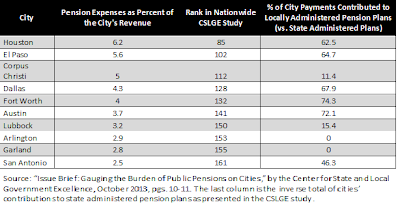
The CSLGE study confirms what we’ve been saying over the years:
1) Texas’ local pensions do not put their cities at financial risk
2) Locally administered pension plans do a good job of managing a balance of city employee pension benefits with the city’s overall financial goals
3) Compared to the statistics of pension systems in other states, Texas is head and shoulders above most, if not all, states on many different measures.
We are very pleased to see this study but we know this alone won’t change the minds of those with a bias against public employee pensions. – Max Patterson
TEXPERS has been fighting this assertion on many fronts, but it’s nice when a third-party organization undertakes a major research project and adds some perspective to the issue.
The Center for State and Local Government Excellence released a study today, “Gauging the Burden of Public Pensions on Cities,” that asks a simple question: “How much do residents of a city pay for pensions—not just for city pensions, but also for school district and county pensions in their jurisdictions?”
To answer the question, the CSLGE researchers used data from 173 cities around the United States, including 10 of Texas’ biggest cities. Their finding was that, across the nation, pension costs average 7.9% of the total revenue base of those cities.
In Texas, our 10 biggest cities are among the bottom half of CSLGE’s 173 city sample, paying the least amount of taxpayer revenue to their pensions. In fact, the pension costs of the ten Texas cities average 4.2% of their tax revenues, nearly a full 50% below the national average.

The CSLGE study confirms what we’ve been saying over the years:
1) Texas’ local pensions do not put their cities at financial risk
2) Locally administered pension plans do a good job of managing a balance of city employee pension benefits with the city’s overall financial goals
3) Compared to the statistics of pension systems in other states, Texas is head and shoulders above most, if not all, states on many different measures.
We are very pleased to see this study but we know this alone won’t change the minds of those with a bias against public employee pensions. – Max Patterson
Subscribe to:
Posts (Atom)