Monday, December 9, 2019

Investment Insights


Personalized Medicine: Wave of the future


By Thomas A. Sternberg/William Blair Investment Management

Historically, the pharmaceutical industry has focused on developing blockbuster drugs for the masses, taking a one-size-fits-all approach. But as we’ve learned more about the role genetics play in inheriting and treating diseases, the opportunity has arisen to treat people in a more targeted way.

This is personalized medicine, which involves getting the right drug to the right patient at the right time, and there are three primary areas of focus: gene therapy, cell therapy, and gene editing.

Gene Therapy


Gene therapy modifies or replaces existing genes, paving the way to cure hereditary diseases. One gene-therapy drug, which treats a hereditary retinal condition that can lead to blindness, is available today. We expect to see at least two more gene-therapy drug approvals in the United States and Europe in 2019.


Cell Therapy


Cell therapy involves the transplantation of human cells back into the body to replace or repair damaged cells or tissue.

One of the most common forms of cell therapy used today is CAR T-cell therapy, in which cells are extracted from a patient’s body, modified in a laboratory to attack cancer cells in the blood, then reinserted into the patient’s body.

CAR T-cell has distinct advantages over other treatments, including that it’s given once and stays in the body, reducing hospitalization time and automatically treating recurrences of the cancer. There are two approved CAR T-cell drugs available today, each treating a different type of blood cancer.


Gene Editing


Lastly, gene editing gives scientists the ability to change an individual’s DNA. Genetic material is added, removed, or altered at particular locations in the genome.

Gene editing took off in 2012 with the discovery of CRISPR-Cas9 technology, which is faster, cheaper, more accurate, and more efficient than other methods.

Although it’s not quite as advanced as other gene therapy and cell therapy approaches, gene editing has a variety of applications. For example, with gene editing we could alter humans’ DNA to make them resistant to certain diseases (like malaria) or even prevent them from acquiring certain diseases (like cystic fibrosis).


Investment Implications


Personalized medicine should lead to better patient outcomes and economic outcomes, because we won’t be giving drugs to patients who might not actually benefit from them. And there are several investment implications.

First and foremost, the pharmaceutical companies that produce and sell these therapies will be watched closely, and there will be challenges along the way. There are complexities in the production, supply chain, and delivery of these drugs to patients that must be resolved, for instance. And new payment models will have to be developed, as these are very expensive but one-time therapies.

We also think there will be opportunities for investors beyond the pharmaceutical companies. For instance, there will also be a greater need for equipment and supplies in the production of these therapies and the supply chain in terms of delivering them, and there will be companion diagnostics.

It will be a fascinating area to watch unfold over the next several years, and we expect there to be opportunities for healthcare investors globally.


The views expressed herein do not constitute research, investment advice or trade recommendations, do not necessarily represent the views of William Blair nor TEXPERS, and are subject to revision over time.

About the Author:

Investment Insights

North American Investors and European Infrastructure


A solution for capital deployment, portfolio diversification and long-term cash flow visibility


By Jane Seto/DWS Group

When it comes to private infrastructure, North American institutional investors have considerable dry powder to allocate.[1] 

The North American infrastructure market is one of the largest in the world and commonly represents the first choice for domestic investors. However, opportunities in North America are concentrated in the energy sector, and may offer limited scope for portfolio diversification.[2]

The European infrastructure market, however, may offer a solution to North American investors, supporting portfolio diversification away from energy.[3] Moreover, European assets in the core/ core plus space often benefit from mature regulatory and concession frameworks, supporting long-term income visibility. In Europe, private infrastructure returns demonstrated a stable performance[4] due to several factors, including a wider portfolio diversification potential by sector and country, and a larger availability of assets in the regulated or contracted space. In addition, North American investors allocating to European infrastructure denominated in EUR may also gain a premium from currency hedging, improving return expectations further.[5] With competition concentrated at the larger end of the market in both regions, Europe also offers a wider set of opportunities in the middle market space where we observe less competition and more sensible pricing. 

North American market focused on energy


Historically, transaction opportunities in North America have been concentrated in energy-related sectors. Renewables, oil & gas and power projects accounted for about 80% of the total number of transactions achieving financial close between 2009 and 2019, with the majority of these projects in the greenfield space. At the same time, transportation deals accounted for 7% of total transactions, a level materially below the European average, where transportation accounted for over 30%.[6]

Looking at the pipeline of upcoming transaction opportunities, investors interested in accessing the North American market today may continue to find limited opportunities for portfolio diversification. Although the pipeline seems more diversified than in the past, energy-related deals should still account for 64% of the pipeline, while transportation accounts for a limited 13%.[7]

Click image to enlarge chart.


Europe: An opportunity for diversification into a mature investment environment 


Europe represents a leading global market for infrastructure investment for its market size and track record, offering opportunities that range from the mature Western European countries, to the fast growing economies of Eastern Europe.[8]


Click image to enlarge chart.

In its report: “North American Investors and European Infrastructure”, DWS’s Infrastructure team analyses how European infrastructure can be a solution for North American investors when it comes to capital deployment, portfolio diversification and long-term cash flow visibility.

To read the full report, visit https://institutional.dws.com.

Resources:
[1] Based on Preqin database as at 7 August 2019.
[2] Based on Infrastructure Journal database, as at July 2019.
[3] Based on Infrastructure Journal, as at June 2019. 
[4] Based on Preqin, “Preqin infrastructure Funds Statistics Database”, as at September 2018, Notes: Infrastructure fund of funds and secondaries have been removed.
[5] Based on DWS proprietary methodology estimating hedging costs on the basis of a three year interest rate swap differential between currency of investor domicile and currency of investment destination, as at 7 August 2019.
[6] Based on Infrastructure Journal, as at July 2019.
[7] Based on nfraNews, as at July 2019.
[8] World Economic Forum, as at August 2019. 

The views expressed in this document constitute DWS Group’s judgment at the time of issue and are subject to change. 

About the Author:

Investment Insights

Image by skeeze from Pixabay.com.
Setting the Pace:
A proactive Fed helps keep the economy on track

By Seamus Smyth/Stone Harbor

“The crashes people remember, but the drivers remember the near misses.” – Mario Andretti

After strong market returns so far in 2019, it’s easy to forget where we were at this point last year. 

In late 2018, a combination of rate hikes by the U.S. Federal Reserve, an escalating trade war and slowing global growth pushed global equity and credit markets down sharply. There was real fear that a recession was imminent. 


Click image to enlarge graph.
That sentiment started to shift in January 2019 when Fed Chairman Jay Powell announced that the Fed would be patient, patience that eventually transformed into the ongoing policy easing. Since the “Powell Pivot,” risk assets—including equities and global credit—have risen dramatically, while interest rates have plummeted. The resulting easier financial conditions have helped to buffer the U.S. economy, as growth has gradually slowed though unemployment remains low. Europe, China and the rest of the world have likewise slowed to varying degrees, but have not slipped into recession.


The Fed’s actions highlight the continued role of central banks in helping markets navigate changing conditions. We think it’s helpful to view the Fed and other central banks as pace cars—also called “safety cars”—which set the pace and position of drivers during a car race. More importantly, pace cars can intervene mid-race if the course becomes treacherous. Much like a pace car, the fed in particular has shown a willingness to take proactive actions when necessary—leading to generally favorable conditions for risk assets.


Looking at the U.S., we believe the risk of a recession remains just a risk—a higher risk than in most of the past decade, but still just a risk for now. The Fed’s actions this year seem to have steadied the U.S. economy, partially offsetting the drag from trade tensions and fading fiscal stimulus. 


Lower mortgage rates appear to be hitting the accelerator for housing, offsetting weaker areas of the economy. Consumer spending remains decent, as low unemployment and modestly firmer wage gains provide support. Those two boosts balance out the ongoing drag from manufacturing. 

Driven by a global manufacturing slowdown and the trade war, the ISM Manufacturing Index declined to 47.8 in September. We’ll continue to closely monitor incoming data, especially jobless claims, as a deterioration in the labor market would increase our concern of a tire blowout for the U.S. economy. Overall, while the data remains mixed, the Fed’s intervention during a period of potential hazard appears to have set the U.S. economy on a more stable course.

Europe, however, has slowed to an even more anemic pace: below 1 percent for the Euro area as a whole, though the slowdown has not been equally distributed across sectors or countries. The same trade tensions hurting the U.S. manufacturing sector have hit the European manufacturing sector, particularly in Germany, where manufacturing comprises a larger share of the economy. 


Germany’s PMI reading has declined sharply, while France and Spain have fallen more modestly. Eurozone core inflation remains stuck at just over 1 percent, well below the European Cental Bank’s (ECB) target of just below 2 percent. As a result, the ECB has taken new actions, including a package with even lower policy rates, more quantitative easing (QE), tiering of reserves and renewed targeted longer-term refinancing operations (TLTROs). We expect these actions will support growth; however, with rates already this low, there has been substantial pushback. In our view, the room to apply more monetary stimulus looks limited, at least in the absence of a more severe downturn. In other words, the policy nudge from the ECB looks a bit weaker than that from the Fed.

China’s economy has also slowed, though more gradually than many had feared given higher U.S. tariffs enacted over the past two years. Determined to control the pace of the economic slowdown, Chinese policymakers implemented various policy easing measures earlier in 2019, and we see evidence these measures are having an impact. As a result, recent data has been mixed. Exports to the U.S. have been down sharply, but Chinese exports to other countries have increased. Housing in China appears stable, though new starts have declined. We’re also seeing signs that Chinese policymakers are calibrating their stimulus to recent economic performance. As the situation seems to have stabilized, China has taken its foot off the gas pedal and slowed down some of its stimulus measures, in particular in the monetary/financial area with a noticeable decline in the credit impulse in recent months.

One common theme is that we believe central banks and other policymakers still have the ability to stimulate their economies, though as we’ve discussed previously, the amount of policy space varies. We expect the Fed to act swiftly if they detect recessionary dynamics. For instance, in the case of meaningful labor market deterioration—an increase in the unemployment rate of more than one or two tenths of a percentage point—we believe the Fed would rapidly move the fed funds rate back to zero. How rapidly? Perhaps over the course of two meetings, with a potential intermeeting cut. We believe the Fed would also return to offering forward guidance, and the re-initiation of explicit QE is a real possibility. Unlike in Europe, the Fed appears quite reluctant to take rates negative, for reasons both practical and political.

Europe has less monetary policy space, but potentially more usable fiscal policy space. As in the U.S., we think it would take labor market deterioration for Germany to take decisive action, but the Germans appear more willing to take such steps than in the past. China has clearly shown its ability and willingness to react aggressively to deteriorating economic conditions, though high leverage has reduced the pace of policy intervention, and policymakers are acting more cautiously than during past slowdowns. Overall, while the track will not always be smooth, our base case remains that the policy pace cars will be successful in keeping the major economy race cars on track.


About the Author:


Investment Insights

Image by Willi Heidelbach from Pixabay.com.

Low Volatility Investing: 

What's missing from investors' analysis?


By Nicholas Alonso/PanAgora

In the past 12 months, investor attention to low volatility strategies has increased as many strategies have handily beaten their capitalization-weighted benchmarks. While we believe there is sufficient academic evidence to suggest that, over time, there will be a positive payoff to low volatility assets; we are not so bold as to believe this payoff will be persistent at all times. Rather than chase attractive alpha, we believe investors ought to consider the benefits of adding some downside protection to their equity asset allocation via Low Volatility Equity strategies.

Will the Low Volatility Premia Continue to Pay Off?


Competing theories on why Low Volatility premia payoff leave us uncertain about the continued alpha potential for these strategies in the near future. One common explanation for the existence of the Low Volatility premia is that Low Volatility stocks are underpriced because of agency friction experienced by asset allocators who look to move away from their capitalization-weighted benchmarks. The fact that such frictions are likely to persist is an argument for the continued existence of the Low Volatility premia.[1]


Conversely, PanAgora’s CIO of Multi Asset, Dr. Edward Qian, has suggested that the performance of Low Volatility stocks typically appears strongest before Federal Reserve monetary easing decisions, which typically occur during times of stress.[2] Low Volatility alpha may thus be a harbinger for downturns in the equity market. If this is the case, the recent performance of Low Volatility strategies may be considered near its end.

Precisely because it is so difficult to forecast the continued alpha generated by these strategies, we believe that the more pertinent factor when deciding to invest in Low Volatility strategies should be downside protection.

Devil Is in the Details: How Portfolio Construction Techniques Impact Downside Protection


Low Volatility strategies seek to provide downside protection by lowering the volatility of the equity portfolio. While this seems like an obvious investment objective there are, in fact, many periods where the general collection of low volatility portfolios did not provide the expected downside protection. The reason for dispersion amongst low-volatility portfolio performance in market downturns is that low volatility is a portfolio characteristic and not solely a stock characteristic. The volatility of a portfolio depends both on the stocks idiosyncratic volatility, but also a stocks co-movement with other stocks in the portfolio. Stocks with low correlations to other stocks can lower the volatility of a portfolio 
even if that stock has a high volatility. Diversification, therefore, is an important feature that is often ignored in low volatility portfolios.
The fact that low volatility is a portfolio characteristic leads to an important observation that there are many different ways to build a low volatility portfolio that each lead to very different performance results. PanAgora has analyzed the outcomes of several low volatility portfolio construction methodologies. 


Our results show that performance of certain strategies, such as minimum variance and maximum diversification, are heavily dependent on which risk model is used as an input to the process. The variability in outcomes that result from simply changing the initial measurements of risk should give investors pause. We believe there is a better way to build low volatility portfolios. One that has shown to be robust to changes in the risk models and that leads to behaviors that are much more in line with the expectations for low-volatility investing.


Click image to enlarge graph.

January 1995 – June 2019. Backtest begins in January 1995 due to data availability. These backtest results presented are gross of fees and are shown for illustrative purposes only. They do not represent actual trading or the impact of material economic and market factors on PanAgora’s decision-making process for an actual PanAgora client account. As with any investment, there is the possibility of profit as well as the risk of loss. Please see the disclosures at the end of this presentation. Source: PanAgora

A Path Forward: Risk Balanced Portfolio Construction


At PanAgora, we have focused the vast majority of our research efforts determining what is responsible for the unexpected results we see in different investment styles. We believe that these unexpected outcomes tend to be driven by a lack of true diversification.  


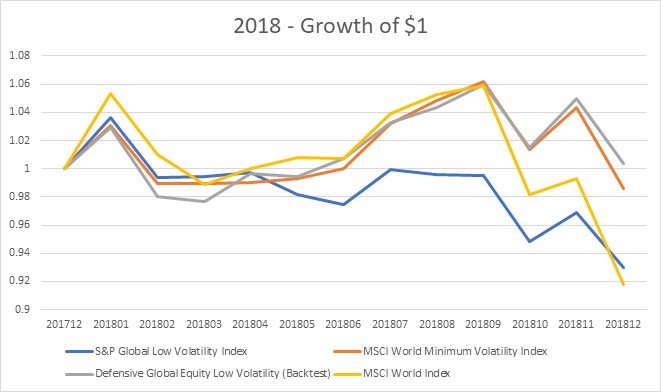
Risk balancing comes from a fundamental belief that “true” diversification is achieved by giving every investment in a portfolio an equal contribution to the risk of a portfolio.[3] We believe diversification in low volatility portfolios leads to outcomes that are both more robust and more in line the expectations of low volatility investing. Certain periods, such as Q4 2018, show that risk balanced portfolio construction may deliver on the expected outcome of low volatility portfolios, whereas other portfolio construction approaches have produced unexpected results.


Click image to enlarge graph.


Past performance is not a guarantee of future results. Performance shown gross of fees. Please see the disclosures at the end of this presentation. Source: PanAgora

Disclosures:
BACKTESTED PERFORMANCE: The model and hypothetical performance included in the presentation does not represent the performance of actual client portfolios. The performance is shown for illustrative purposes only.

Resources:
[1] Baker, M., Bradley, B., & Wurgler, J. (2011). Benchmarks as Limits to Arbitrage: Understanding the Low-Volatility Anomaly. Financial Analysts Journal, 67(1). Retrieved from http://people.stern.nyu.edu/jwurgler/papers/faj-benchmarks.pdf
[2] Qian, E., & Qian, W. (n.d.). The Low-Volatility Anomaly, Interest Rates, and the Canary in a Coal Mine. The Journal of Portfolio Management , 43(4), 3–12.
[3] “On the Financial Interpretation of Risk Contribution: Risk Budgets Do Add Up.” Journal of Investment Management, Vol. 4, No. 4 (2006), pp. 41-51.


About the Author: