Showing posts with label returns. Show all posts

Tuesday, August 25, 2020

The Case for a Permanent Allocation to an Equity Stabilization Strategy

Image by Samuel F. Johanns from Pixabay

By CRAIG STAPLETON & JEREMY GOGOS/Securian Asset Management

Key Points

  • Institutional investors face a balancing act between two equally important needs: achieving robust long-term returns while avoiding the painful consequences of near-term drawdowns.
  • Traditional asset allocation, risk parity and other hedging strategies have failed to perform as expected during recent downturns. Fixed income assets have moved closely in line with equities in times of crisis.
  • Equity volatility levels exhibit a persistent and reliable relationship with equity returns over time and through market cycles, including the latest market crisis, as illustrated for large cap U.S. equities in Chart 1.
  • A permanent strategic allocation to an equity stabilization strategy that utilizes the persistent volatility/return relationship can improve investors’ long-term risk/return ratios – even if implemented right after a market selloff. A rules-based approach, using the reliable indicator of recent volatility, can be successfully applied at any time via a spectrum of implementations against single or multiple risk asset class portfolios.

Chart 1: There is a Clear Relationship Between Monthly Equity Returns and Recent Volatility

Average Monthly S&P 500 Returns for Ranges of Realized Monthly Volatility
(January 1, 1928 – March 31, 2020)

Click chart to enlarge. Source: Bloomberg. Data as of April 1, 2020. The data spans from January 1, 1928, to March 31, 2020, and the table displays the average monthly returns for the S&P 500® for the time periods shown where the average monthly volatility was in the different volatility categories shown. Volatility is measured as the annualized standard deviation of daily returns of the index. The S&P 500® Index is an unmanaged index of 500 stocks that is generally representative of the performance of larger companies in the U.S and investments cannot be made directly in the indices. See additional disclosures at the end of the materials for additional information.


Risk Assets: Investors Manage a Double-Edged Sword

Institutional investors face the pernicious dilemma of having mutually conflicting needs. When building a portfolio, investors start with the understanding that, over the long term, expected return and volatility are strongly positively correlated. Unfortunately, most investors need both significant levels of return to meet their long-term goals and a stable stream of returns to ensure financial viability. A defined benefit pension plan, for example, needs solid returns to meet its actuarial funding goals and pay pensions, while it needs stability to avoid erosion of its funded status.

For institutional investors seeking stable funding, the same risk assets that provide essential upside potential also represent significant exposure to downside risk and unstable results. Although investors’ need for risk mitigation is high, most investors have not implemented such strategies to date, for reasons we discuss below.

The Risks of Managing Risk: Why Most Portfolios Remain Exposed

For a risk mitigation strategy to be reliable, it must be built on a market relationship that is persistent over time. Unfortunately, most risk mitigation strategies to-date have been based on historic correlations that have broken down during strong bear markets, when they are most needed.

Fixed Income is an Anchor to Windward Until a Hurricane Comes

A common approach to mitigating equity volatility risk is the classic asset allocation strategy combining equity and fixed income assets, for example in the traditional 60/40 portfolio. The logic is that the two asset classes are negatively correlated most of the time, so fixed income serves as a portfolio’s ‘anchor to windward’ when volatile equities experience periodic selloffs.

Unfortunately, the correlation between fixed income and equity investments is not stable through time. As Chart 2 illustrates, there have been long periods where equities and bonds were positively correlated, and thus traditional portfolio diversification did not reduce portfolio risk.

Chart 2: Fixed Income is Not a Reliable Equity Hedge

3-Month Rolling Correlation – S&P 500 and Bloomberg Barclays U.S. Aggregate Bond Index
(January 1, 1989 - March 31, 2020)

Source: Bloomberg Barclays US Aggregate Bond Index and Securian Asset Management, Inc. Data as of April 1, 2020. The data spans from January 1, 1989, to March 31, 2020, and displays analysis of two indices, the 3-month rolling correlation of the S&P 500 vs. the Bloomberg Barclays U.S. Aggregate Bond Index. The blue circles highlight the specific periods of time. Click chart to enlarge.

In crises — when an offset to downside equity risk is most needed — equities and fixed income often sell off at the same time. During the COVID-19 crisis, the correlation between fixed income assets and equities quickly became much less negative, diluting fixed income’s portfolio diversification benefit. Further, there have been extended periods of time where fixed income was positively correlated with equity. Both are highlighted in the circles in Chart 2.

Volatility is a Reliable Indicator of Equity Performance

A persistent and reliable relationship exists between 1-month volatility and 1‑month equity returns, both positive and negative. Volatility episodes tend to demonstrate persistence. As Chart 3 clearly shows, since 1928, for the S&P 500, high 1-month volatility tends to be associated with poor 1-month returns; and vice versa.

Chart 3: Since 1928, Volatility Levels Have Reliably Signaled Equity Returns

Average Monthly S&P 500 Return vs. Average Monthly Realized Volatility

(January 1, 1928 - March 31, 2020)
Source: Bloomberg, Securian Asset Management, Inc. Data as of April 1, 2020. Data spans from January 1, 1928, to March 31, 2020, and displays the average monthly S&P 500 return vs. the average monthly realized volatility. Click chart to enlarge.

While we use the S&P 500 for the illustration above, our research shows the same relationship between volatility and returns across other equity markets. 

Volatility-Based Equity Stabilization Strategy Can Improve the Risk/Return Ratio

A strategy based on the reliably strong relationship between equity volatility and returns is well-suited to deliver portfolio risk mitigation in a more consistent manner than traditional asset allocation. An Equity Stabilization Strategy systematically adjusts equity exposures based on the volatility/return relationship. This approach holds greater equity market exposure during lower volatility periods, which tends to lead to better performance, as illustrated in Chart 3. Conversely, we believe this approach can quickly reduce equity market exposure during the higher volatility periods that tend to produce unfavorable performance, mitigating the drawdown of assets.

The Case for a Permanent Strategic Portfolio Allocation to Volatility-Based Equity  Stabilization Strategies 

To-date, institutional investors have implemented volatility-based stabilization strategies sporadically or not at all. We believe this reticence is due to two key investor concerns: Portfolio risk hedging is complex, and a desire to avoid periodic carrying costs of hedging – particularly right after a major market selloff.

A permanent strategic allocation to a systematic volatility-based approach over a full market cycle addresses both of these issues.

The Straightforward Principle of Volatility-Based Stabilization Strategies 

A simple set of rules using 1-month risk asset volatility as the principal metric is the foundation of an equity stabilization strategy. A strategic overlay primarily employing listed equity index futures ensures transparency and simplicity while avoiding counterparty risk.

Implementing Volatility-Based Risk Mitigation is Straightforward

The Stabilized Equity Portfolio Hypothetical Example, is based on a pension plan aiming to reduce its domestic U.S. equity annualized volatility by about 25% from its historic average level of around 18% per annum. In this hypothetical, the pension fund added a futures-based overlay on top of its equity portfolio, using listed S&P 500 futures to dial the effective equity exposure up or down based on volatility. Using this overlay, the portfolio manager allows the portfolio’s effective equity position to drop down to 20% of the portfolio’s net assets in high volatility environments and increase it to as much as 150% in low volatility environments.

Chart 4: Equity Stabilization Strategy Improves Risk/Return

Stabilized Equity Portfolio Hypothetical Risk & Return

(January 1, 1988 - March 31, 2020)
Source: Bloomberg, Securian Asset Management, Inc. The data spans from January 1, 1988, to March 31, 2020, and displays the hypothetical backtested returns of a hypothetical portfolio created for illustrative purposes only. No investor actually achieved the results shown. No representation is being made that any account will or is likely to achieve results similar to those shown. Please see important disclosures on the limitations of hypothetical backtested performance at the end of the materials. Click chart to enlarge.

Skillful Implementation Adds Further Value to a Stabilization Strategy

The pension fund’s overlay manager should take the following steps:

  • Run the overlay model daily
  • Combine experience-based judgement and additional subsidiary indicators such as the VIX and high-yield spreads to better assess the likely volatility environment daily
  • Primarily use listed futures, and use listed options when inexpensive or more attractive
  • Employ strict trading rules to protect the pension fund from being whipsawed in rapidly changing market environments
  • Employ strong derivatives governance and oversight

Balanced Portfolios Benefit as Well

Using a volatility-based risk mitigation strategy on the equity portion of a balanced portfolio is an effective way to adjust the equity/bond mix to changing risk environments, without the costs and timing issues of selling the underlying assets.

Positive Full Market Cycle Cost/Benefit

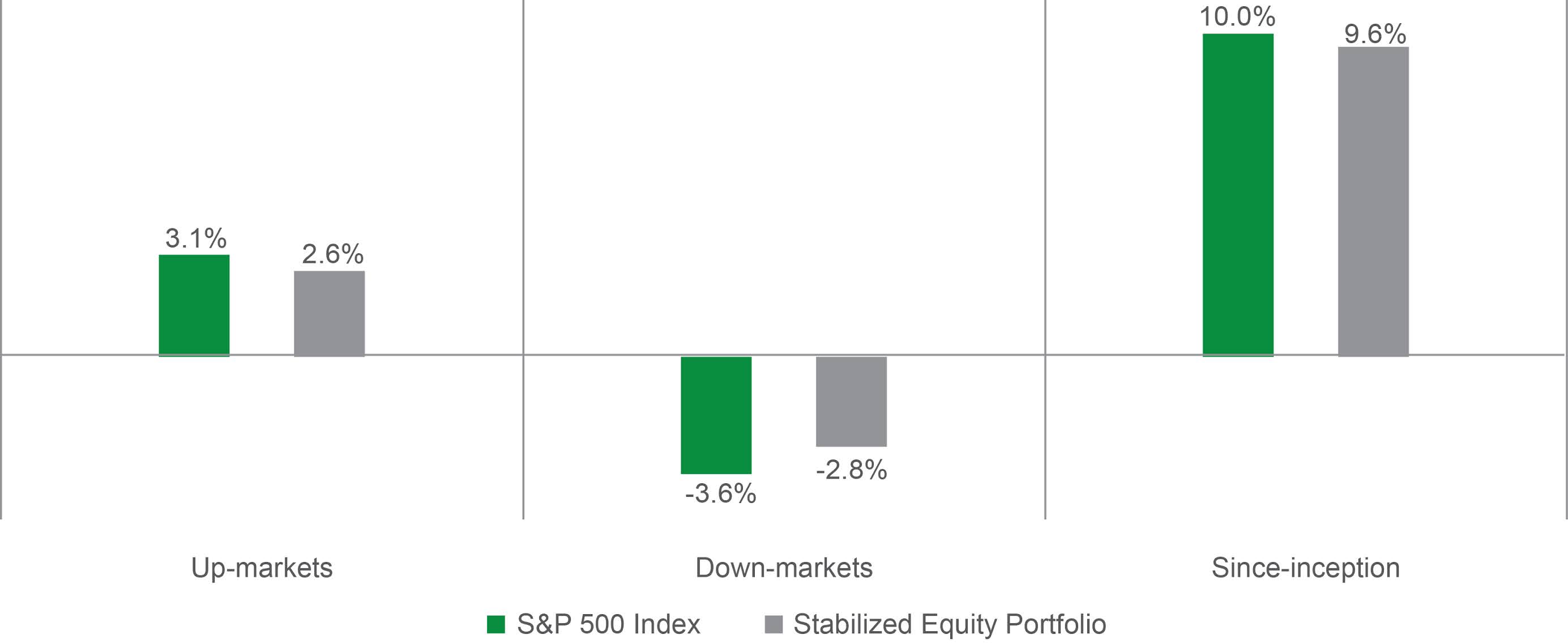
When a volatility-based portfolio risk management approach is maintained throughout a full market cycle, its outperformance in down markets can offset its underperformance in up markets, rendering a market-like return over a full cycle.

Chart 5: Thoughtful Equity Stabilization Can Pay for Itself Over a Full Market Cycle

Average Monthly Returns of the S&P 500 Index and the Stabilized Equity Portfolio Hypothetical Example in Up Markets, Down Markets, and Longer-term
(January 1, 1988 - March 31, 2020)
Source: Bloomberg, Securian Asset Management, Inc. The data spans from January 1, 1988, to March 31, 2020, and displays the hypothetical backtested returns of a hypothetical portfolio created for illustrative purposes only. No investor actually achieved the results shown. No representation is being made that any account will or is likely to achieve results similar to those shown. Please see important disclosures on the limitations of hypothetical backtested performance at the end of the materials. Click chart to enlarge.

Implementing a volatility-based risk mitigation approach by means of a derivative overlay means there is no disposition of underlying assets, merely a modification of risk exposures, thus avoiding trading costs and buy/sell spread costs. While there may be periodic ‘carrying costs’ of foregone performance in a bull market, the strategy tends to pay for itself over a full market cycle – avoiding the extensive long-term portfolio damage that a liquidity crisis during a bear market can wreak – as shown in Chart 5, above.

Portfolio Hedging is Vital after a Market Selloff

Perhaps counterintuitively, a volatility-based stabilization strategy is vital after a severe market shock, such as the recent COVID-19 pandemic shock.

After an historic downturn in the markets, most institutional portfolios are significantly underweight equities. In order to benefit fully when the markets inevitably recover – and in order to rebalance to their strategic asset mix targets – institutions need to re-risk by adding to their equity exposures.

This may be a difficult decision for many institutions, because the market bottom is only known to have occurred well after the fact. A reliable risk management strategy, such as the kind of volatility-based approach described in this paper, enables institutions to re-risk without needing to have certainty about the market bottom, as it entails significant protection against further drawdowns and yet will participate when the market recovers.

Summary: A Permanent Allocation to Volatility-Based Risk Mitigation is a Strategic Necessity for Institutional Investors

An airbag must be permanently installed in a car in order for it to deploy when it is needed – during the moment of impact, the timing of which cannot be predicted.

Similarly, we believe institutional investors obtain the best results from a stabilization approach based on volatility when they make it a full-time strategic allocation in their portfolios. A permanent strategic allocation to volatility-based stabilization ensures investors and their beneficiaries can benefit from the consistent and sustained mitigation of volatility shocks on an ongoing basis.

Securian Asset Management is an Associate Member of TEXPERS. The views expressed in this article are those of the authors and not necessarily Securian Asset Management nor TEXPERS.

About the Authors

Craig Stapleton, CFA, FRM is Senior Vice President – Head of ALM & Quantitative Strategies at Securian Asset Management. As Vice President and Portfolio Manager, Stapleton is responsible for derivatives, agency MBS, government and municipal bonds, quantitative analytics, cash management, ALM and strategic asset allocation for the Minnesota Life General Account. He is the head of the quantitative analysis and research group. Stapleton is also the co-portfolio manager for the Equity Stabilization strategies and the Securian Asset Management Strategic Dividend Income portfolios. Prior to his role as portfolio manager, Stapleton provided quantitative analysis, security and portfolio risk statistics, and derivatives hedging capabilities for Securian Asset Management and its clients. Stapleton is a CFA Charterholder, and a member of the CFA Institute and CFA Society of Minnesota.


Jeremy Gogos, Ph.D., CFA, is Vice President and Portfolio Manager of Quantitative Strategies at Securian Asset Management. He monitors domestic and international equity volatility and correlation, manages fund equity exposure, and evaluates equity allocation model performance. Gogos provides quantitative analysis, security and portfolio risk statistics, and execution of derivative and hedging initiatives. He has also supported annuity, life insurance, and investment product designs with stochastic and historical simulation and performance evaluation. Prior to joining Securian Asset Management, Gogos was a computer programmer supporting Securian Retirement’s 401(k) recordkeeping and trading platforms. He is a CFA Charterholder, and is a member of the CFA Institute and CFA Society of Minnesota.

Friday, June 21, 2019


BY JIM MCKEE, Callan

Looking for improvement from your hedge fund allocation? Co-investing with hedge funds is a chance for investors to enhance returns while reducing overall fees.

Although co-investments have been a popular supplement to a fund sponsor’s private equity and real estate programs for decades, co-investing with hedge fund managers became a widespread practice only after the global financial crisis of 2007-2008.

The appeal of co-investing with hedge funds today arises from attractive opportunities that lie between the vast pools of liquid capital markets dominated by algorithms and indexers on one side, and the mountain of dry powder controlled by private equity providers on the other.

What are co-investments?

Co-investments are one-off investments that a hedge fund manager has identified which are typically too illiquid or oversized to absorb within the manager’s flagship fund. Another key feature of such opportunities is that they need to be assessed quickly for a decision to buy or pass—often within days or weeks. 

Fast-moving markets or events are frequently forcing the trade; being able to respond within a few days or weeks is the key for successful participants. Because market values of such opportunities are often not observable due to their size or illiquidity, the allure for co-investors is an asset trading at a notable discount to fair value, in addition to lower fees charged by the sourcing manager versus its commingled fund vehicle.


What have co-investments looked like in the past? 

Depending on the manager’s domain expertise, they could be Lehman claims, Icelandic bank debt, Puerto Rican bonds, Argentinian debt, Egyptian T-bills, CLO equity tranches, late-stage private equity, or an activist-controlled stake in a targeted public stock. Other investment opportunities may not be co-investments, per se, but are similarly attractive to experienced buyers looking for direct investments offered by motivated sellers at a material discount, such as hedge fund secondaries.


Motives behind offerings

Motives behind managers offering co-investments are many. In addition to a position being too big or too illiquid for their primary commingled fund, co-investments represent an opportunity to create and improve relationships with strategic clients while developing a supplemental revenue base. Since co-investments are usually offered under carefully described circumstances, investors in such opportunities should not construe them as the manager’s “best ideas”—one should expect those to continue going first into the manager’s flagship fund.


Investor expectations

Since co-investments are offered at lower fees, the investor’s expectation should be to improve performance at least by reducing the fees being charged. A collateral benefit is that co-investing efforts provide improved access to deal flow via dedicated sourcing experts. Furthermore, co-investing provides more transparency into a manager’s investment process. Because the manager’s compensation is typically driven by incentive fees, the investor can also be more confident in aligned interests to create desired investment outcomes. Nevertheless, working with multiple co-investing partners helps to improve diversification of trade risks.

Because resources and experience widely vary among investors, co-investment solutions have three primary forms to consider:

  1. If limited partners lack resources to quickly vet and approve opportunities presented to them, they can consider a turnkey solution provided by a fully discretionary adviser, whether a hedge fund or fund-of-funds manager. The adviser of this turnkey solution sources the co-investment deals, underwrites them, and uses its full discretion to implement a commingled fund solution. It is the most fee-laden solution, but it is cheaper than the manager’s full-fee commingled fund.
  2. Limited partners with demonstrated experience and ability to move quickly on any presented opportunity can oversee a managed account of approved co-investments that conforms to customized investment guidelines set up with the manager.
  3. If an investor has significant size, experienced staff, and demonstrated resources, it can be a strategic partner working with manager sourcing, vetting, and investing directly in deals.
Like any private transaction lacking clear pricing or exit strategies, the motives of all participants are particularly important to understand. Investors need to know their limitations and act accordingly. When opening the door of co-investment opportunities, carefully understand your odds of investment success before the door shuts behind you.

The views expressed herein do not constitute research, investment advice or trade recommendations, do not necessarily represent the views of Callan nor TEXPERS, and are subject to revision over time.

About the Author: 
Jim McKee is a senior vice president in Callan's Hedge Fund Research group. He is a shareholder of the firm. McKee earned a master's degree in finance from Golden Gate University in 1987. He received his bachelor's degree in economics/environmental studies from Dartmouth College in 1982.


The Challenge: Generating Sufficient Returns


BY BOB PARISE, Northern Trust Asset Management

Increasing pressure to reduce risk coupled with a challenging market environment will make generating sufficient pension returns harder in the coming years. Volatility has returned, the yield curve has flattened and global growth has slowed — all of which can contribute to lower future returns.

To illustrate the magnitude of these negative shifts in the return expectations, we utilized our five-year risk and return forecasts to simulate various optimal portfolio outcomes. Compared to just 10 years ago, these hypothetical diversified portfolios have a ~2% drop in returns across all levels of risk, which compounded over time, can become a significant unfunded liability for pension plans.

Historical approaches to bolster returns generally involved increasing certain risk exposures, such as adding alternative and private investments. However, some plan sponsors are limited in the amount that they can increase their risk budgets. Others are already at their liquidity limits for more aggressive allocations. These limitations diminish a plan sponsor’s ability to meet its target return objectives of 6% to 7.25% without taking too much risk.

The Solution: Quantitative Multi-Factor Strategies

Multi-factor strategies could offer a consistent alpha contributor to your equity allocation without increasing your pension’s risk budget.


What Are Multi-Factor Strategies?

Factor-based, or quantitative, equity strategies seek to outperform a benchmark by exploiting market anomalies and behavioral biases using proprietary and quantitative models to select securities, construct portfolios and manage risk to deliver targeted outcomes.


Click image to enlarge.


Why Invest in Factors Now?

We do not advocate trying to “time” factors over short periods of time, but it is important to note the cyclical nature of factor returns. Factors have tended to perform well in any economic environment, but they have historically been at their best when the economy is moving out of periods of high expansion (Exhibit 1).


Click image to enlarge.

While markets can be cyclical, in our 20+ years of managing factor-based strategies, we’ve found quality to be a diversifier that potentially makes outperformance more consistent over varying returns cycles.

Similarly, in rising rate and low return environments, we have seen the same pattern of high excess returns, primarily in the low volatility and quality factors (Exhibit 2). While not all of these factors may align with your plan’s objectives, this framework can provide a helpful guide to gauge whether your portfolio is aligned to capture these potential drivers of outperformance.


Click image to enlarge.

Learn more about multi-factor strategies on northerntrust.com or contact Bob Parise.

The views expressed herein do not constitute research, investment advice or trade recommendations and do not necessarily represent the views of Northern Trust Asset Management or TEXPERS. Click here to read Northern Trust Asset Management's full disclosure.

About the Author
Bob Parise is practice lead, Public Funds & Taft-Hartley Plans at Northern Trust Asset Management and a member of the Business Leadership Council. Parise has more than 24 years of financial industry experience, most of it at J.P. Morgan Asset Management and its predecessor firms. He earned a bachelor's degree in Finance from Western Illinois University and a master's degree from DePaul University. He holds Series 3, 7, 24, and 63 licenses.


Friday, February 23, 2018


Assessing the Merits of 

long-only equity allocations


By Marlena Lee, guest columnist

Investors continue to search for effective ways to structure their long-only equity allocations.

Many passive approaches have offered diversified exposure at low management fees with a minimal governance burden. However, concerns about the potential for a sustained period of lower returns have prompted some investors to revisit their decision to index and contemplate adding factors to their portfolios. Assessing the merits (and limitations) of any “factor-based” approach requires asking some seemingly fundamental but important questions:

  • Why should there be differences in expected returns across stocks? The chance that all stocks have the exact same expected return is virtually zero. There is a multitude of reasons why different stocks should have different expected returns, such as differences in risk or differences in investor preferences.
  • How can you identify these differences in expected returns? A good rule is that investors should not rely solely on back-tested results. There is a saying in statistics – if you torture the data long enough, it will confess to anything. A sound theoretical and empirical framework reduces the chance that a coincidental pattern in historical stock data will affect our conclusions.Valuation theory suggests the price of a stock depends on a few variables. One is what the company owns minus what it owes (book value). Another is what investors expect to receive from holding the stock (expected profits) and the discount rate they apply to those expectations (the investor’s expected return). This framework provides very useful insights. One insight is that the expected return investors demand for holding a stock drives its price. Another is that combining price with book value and expected profits allows us to identify differences in expected returns across stocks. For a given level of expected future profits, the lower the price, the higher the discount rate. For a given price, the higher the expected future profits, the higher the discount rate. Empirical analysis is also important – it can help inform expectations about the magnitude of premiums and build confidence that the premiums we see in the historical data are not there by chance. There are numerous studies documenting size, value, and profitability premiums using many different empirical techniques on large data sets—90 years of US data, 40 years of non-US developed markets data, and 30 years of emerging markets data. If we can expect premiums and have a good way of identifying them, we still need to assess how best to capture them.
  • How confident are you that premiums can be captured? What are the risks? If the premiums can be pursued in a well-diversified strategy, this improves the likelihood they can be captured by investors. Why? If results are driven by a small group of stocks or a small percentage of market cap, it is more likely to be a chance result. Additionally, less diversified strategies pursuing premiums are likely to have higher turnover and higher costs.  

Our experience is that using current market prices is important in identifying and capturing premiums. Combining current prices with company fundamentals creates an instantaneous snapshot of differences in expected returns. At that specific instance in time, stocks with lower relative prices and/or higher profitability have higher expected returns. If there is a spread in relative prices at any point in time, we should expect a value premium. This implies we can use current prices to continually focus on higher expected returns.

This does not mean that higher expected returns will be realized continuously, or even consistently.  For example, it is not unprecedented to see value stocks trail growth stocks over a 10-year period. A period of underperformance like this, however, is not by itself compelling evidence that one should no longer expect a value premium in the future. While there is a non-zero probability that any realized premium can be negative over any given investment horizon, that probability decreases over longer investment horizons.

While we encourage a long-term focus, we acknowledge that doesn’t make any underperformance over the short term less disappointing. Asset owners must be willing to accept that uncertainty as part of investing in premiums, just as they do investing in equities. Asset managers can help by not adding to that uncertainty through chasing chance results or inefficiently targeting premiums.

We believe a strong partnership with clearly set expectations, a long-term focus and expertise in implementation can translate to better outcomes for intermediaries and, ultimately, plan participants.

Dimensional Fund Advisors LP, an investment advisor registered with the Securities and Exchange Commission, receives fees for investment management services provided to client members of TEXPERS. There is no guarantee of strategy success. This information should not be construed as investment advice.

About the Author
Marlena Lee
Marlena Lee is co-head of research and vice president at Dimensional Fund Advisors in Austin. As co-head of research, Lee helps manage the firm's general research efforts. She shapes the research agenda by working with clients and the Sales and Investment teams to identify research topics on a variety of investment-related matters that may be useful to clients, including asset pricing, asset allocation, and retirement. Lee is also a member of the Investment Research Committee. Prior to joining Dimensional, she worked as a teaching assistant for Nobel laureate Eugene Fama, a professor at the University of Chicago Booth School of Business. Lee earned her doctorate in finance and a master's degree from the Chicago Booth School of Business. She also holds a Master of Science in agricultural and resource economics and a Bachelor of Science in managerial economics from the University of California, Davis.