Showing posts with label securities. Show all posts

Wednesday, June 24, 2020

Accelerating secular shifts are reshaping industries


The COVID-19 pandemic is disrupting the lives of people around the globe and changing consumer behavior in real time. While the long-lasting impacts of this pandemic are yet to be seen, we believe the virus is rapidly accelerating several big-picture secular shifts within certain industries that have been developing for years.


The Rise of E-Commerce and Digital Payments

The demise of traditional retail has long been predicted. As the COVID-19 crisis unfolds, more consumers are now shopping online, primarily due to the shutdown of nonessential brick-and-mortar stores amid government shelter-in-place policies and fears surrounding the spread of the COVID-19 virus. The easing of shutdown orders is unlikely to curtail this shift, which we now expect to occur at a faster rate than we were previously anticipating.


We believe the increased adoption of e-commerce will continue as the convenience and comfort of online shopping will likely result in a permanent shift in consumer behavior. Additionally, some smaller retailers may not survive the extended shutdown, resulting in fewer traditional shopping options, and many consumers may remain reluctant to return to physical stores due to fears of contracting the COVID-19 virus.


Some traditional retailers operate through multiple distribution channels, including both e-commerce and brick-and-mortar stores, allowing them to benefit from the accelerated shift to e-commerce. However, as more consumers shop online, in-store sales are likely to remain muted, putting pressure on the margins of many traditional retailers that operate brick-and-mortar stores throughout the country.


We expect select leading traditional retailers with loyal customer bases and large existing e-commerce operations to successfully navigate the shift. As expected, major online retailers, as well as companies that provide e-commerce infrastructure to other companies, are positioned to tremendously benefit from this shift.


Similarly, the use of cash as a payment method has been declining for decades amid the popularity of credit cards and digital payments. Currently in the United States, more than half of the transaction volumes are completed using credit cards.


Globally, however, that percentage is lower as the use of cash is much more prevalent. We see that poised to change, as concerns about contracting COVID-19 are likely to prevent people from carrying and handling cash and the growing popularity of e-commerce will likely spur the increasing use of digital payment methods.


The Shift Away From Linear Television

The use of linear television has been on the decline as video-on-demand (VOD) services and digital media are gaining popularity. The COVID-19 crisis is likely to accelerate this shift as shelter-in-place orders have kept people indoors with fewer entertainment options.


New content production and sports programming, which we view to be the primary advantage of subscribing to linear television, have also been put on hold as a result of COVID-19. We believe these factors will accelerate the shift toward VOD services as consumers may begin to realize the cost savings associated with these types of services, particularly in the absence of sports programming and advertisement interruptions that come with traditional programming.


Additionally, as linear television continues to lose viewers, we expect advertising dollars to shift toward various online and digital channels, furthering the demise of linear television. Roughly 20% of the U.S. population has already cut the cord, and we believe another 20% will follow suit over the next few years.


The Rapid Transition to the Cloud

Corporations have traditionally run their own data centers and invested in the necessary employees and equipment to do so. However, over the past few years, more companies have shifted to using enterprise cloud computing services for at least a portion of their software and processing needs.


The strategic benefits of cloud computing are plentiful—enhanced data security and optimization, scalability, reduced capital expenditure and operating costs, and improved mobility, which has quickly become a critical factor in the wake of the COVID-19 pandemic.


Efforts to contain COVID-19 have forced many companies to transition their employees to a work-from-home environment, which has prompted those that do not have the data center infrastructure necessary to support such a transition to outsource these needs. Companies that provide cloud computing and migration services have become instrumental in allowing businesses to transition to the cloud quickly and seamlessly.


We believe this experience is likely to force companies to acknowledge the importance and benefits of using the cloud and reevaluate their technology infrastructure.


It is estimated that about 15% of corporate processing needs, otherwise known as workloads, currently occur in the public cloud. While we expected that number to grow to more than 50% over the next few years, the pandemic has rapidly accelerated this transition over the past couple of months. As this trend continues to accelerate, well-established, dominant players in the enterprise cloud computing space are poised to benefit as they are able to provide the ample security, vast reach, significant cost savings, and required infrastructure.


An Increasingly Remote Workforce

Working from home is not a fad, in our view. As we previously mentioned, the COVID-19 crisis has forced many companies to transition their employees to a work-from-home environment. As a result of this, we believe corporations have discovered that employees who work from home can be just as effective and productive as they would be in the office, if not more so.


From a technology standpoint, previous obstacles that may have prevented companies from allowing employees to work from home will likely no longer be an issue as enterprise cloud computing services have enabled a smooth and seamless transition to a remote work environment.


We believe remote work is here to stay in some form or another, even after shelter-in-place orders have been lifted.


Companies are likely to be cautious in bringing employees back to traditional offices, at least until there is a solution to the COVID-19 dilemma, for fear employees could contract the virus during commutes or in crowded offices. Staggered schedules that reduce office density—where groups of employees alternate which days they work from home—will likely become common. Additionally, cost savings associated with a reduced need for office space will likely further motivate employers to shift to an increasingly remote work environment.


Supply Chain Diversification

We believe some companies had already started to rethink their supply chains and manufacturing sources heading into the COVID-19 crisis.


As the U.S.-China trade war intensified, companies began restructuring their supply chains to rely on multiple sources, including shifting a portion of manufacturing to other regions, rather than relying on a single source such as China. We believe this trend will accelerate, as the COVID-19 pandemic has highlighted the risks associated with the absence of a diversified supply chain.


This risk has been especially evident in healthcare. There have been shortages of critical personal protective equipment, a significant amount of which is manufactured in China, along with many basic pharmaceutical drugs. In an effort to be more prepared for future crises, we believe the U.S. federal government is likely to encourage U.S. healthcare companies to shift at least a portion of their manufacturing back home and to help set up a more robust U.S. medical testing infrastructure.


Past performance is not indicative of future returns


Investing involves risks, including the possible loss of principal. Equity securities may decline in value due to both real and perceived general market, economic, and industry conditions. Individual securities may not perform as expected or a strategy used by the Adviser may fail to produce its intended result. Different investment styles may shift in and out of favor depending on market conditions. Any investment or strategy mentioned herein may not be suitable for every investor.


About the Author: 

Friday, February 23, 2018


Still Having Trouble Getting Your 

Money Back? You're Not Alone

By Jonathan R. Davidson, guest columnist


Over the last decade, we have checked in periodically on the state of claims administration in securities class actions for United States public pension funds. At every turn, we have seen challenges confront the public pension community, making it harder to recover their respective share of proceeds from these cases. From difficulty maintaining historical data necessary to perfect a claim form, to the proliferation of cases being litigated around the globe post-Morrison v. National Australia Bank, claims administration continues to be a thorny issue for public pension funds. This article will examine what is happening in today, review current issues for investors, and provide some best-practice suggestions 
The Current State of Claims Administration

According to NERA Economic Consulting, between 2005 and 2016, over $62 billion dollars in securities class action proceeds were made available to investors. While public pension funds have a fiduciary duty to take reasonable steps to recover these funds, claims filing participation remain strikingly low. Recent estimates suggest only about 35 percent of eligible institutional investors file claims in U.S. settlements.

Recent Issues Causing Grief for Public Pension Funds

To add to the challenging claims administration process, new issues have arisen to further muddy the water.

Change of Custodian
Custodial change can give rise to an overlooked issue in the claims administration process. When a class period in a securities case spans the time of the custodial transition, the former custodian and the new custodian might each have insufficient data to file a complete claim on the client’s behalf.  When this happens, and two claim forms are submitted (one by each custodian), the claims are frequently rejected by the claims administrator as deficient.  If these deficiencies are not remedied (which we believe is almost always the case), the result can be a significant lost opportunity for the pension fund.

Former Custodians No Longer Filing Claims
Many custodians are simply getting out of the claims filing business altogether for former clients (or charging fees for this service).  This presents public pension funds with a difficult choice.  If a fund has all of their transaction history in-house, they might be able to work with their current custodian to construct a claim form which requires both older and newer transaction history.  If the institution does not have the old transaction data, they are at the mercy of the former custodian – either pay a fee to have them file or give up a percentage of the recovery.  Neither scenario is particularly attractive and gives rise to the risk of failure to recovery proceeds. 

Current Custodians Outsourcing Claims Filing
Some custodial banks are now outsourcing claims filing responsibilities to third-party filers, which begs the question: was this disclosed to the Board?  We have seen multiple instances where a public fund was not aware their custodian was not handling the claims filing process in-house.  While the end result may not prove harmful, at a minimum, public funds should know which vendor is doing this work.  Further, we have observed significant differences in the accuracy of claim filing by paid third-party filers – making this potentially more than a simple disclosure problem, and an issue which could result in the failure to recover. 

What Can Public Pension Funds Do To Improve?

The claims administration process continues to evolve. So must the processes that public pension funds have in place.  A few suggestions:

  • Discuss how much money you have received from securities class action settlements/judgments?  What claims have been submitted and are awaiting distribution?  Did you miss out on submitting a claim for a U.S. case? Were you not able to participate in the recovery of a non-U.S. jurisdiction settlement because you never registered for it?
  • Conduct a historical and on-going audit of your custodial bank/third-party filer to check their claims filing accuracy.  If missed claims are identified, immediately contact the claims administrator to see if you can submit a late claim/remedy a deficient one.  This can often be done as long as settlement proceeds have not been distributed.
  • To avoid an issue when changing custodians, consider including a provision in all custodial agreements to ensure your transaction data is returned at the end of the contractual relationship. 

Conclusion

Claims administration will never be Agenda Item #1 at your Board meeting -- public pension funds simply have more important issues to deal with in running their plans.  That being said, with the truly global nature of securities litigation in this post-Morrison world, public pension funds should continue to be vigilant in this area. The significant proceeds generated from securities class action settlements/judgments are an asset owed to you – do what you can to ensure you are getting it back.
The views expressed do not constitute research, investment advice or trade recommendations and do not necessarily represent the views of Kessler Topaz Meltzer & Check, LLP, or TEXPERS.

About the Author
Jonathan R. Davidson
Jonathan R. Davidson, a partner of the Kessler Topaz Meltzer & Check, LLP, concentrates his practice in the area of shareholder litigation. Davidon currently consults with institutional investors from around the world, including public pension funds at the state, county and municipal level, as well as Taft-Hartley funds across all trades, with regard to their investment rights and responsibilities.  
Davidson assists clients in evaluating and analyzing opportunities to take an active role in shareholder litigation.  With an increasingly complex shareholder litigation landscape that includes securities class actions, shareholder derivative actions and takeover actions, opt-outs and direct actions, non-U.S. jurisdiction opt-in actions, and fiduciary actions, he is frequently called upon by his clients to help ensure they are taking an active role when their involvement can make a difference, promote corporate accountability, and to ensure they are not leaving money on the table.  


A Case for Midstream Hybrids

By Shalin Patel, guest columnist

We view midstream hybrid securities as an attractive investment for enhancing yield (6-10 percent) and total return to a portfolio without taking on significant underlying equity volatility or commodity price uncertainty.  
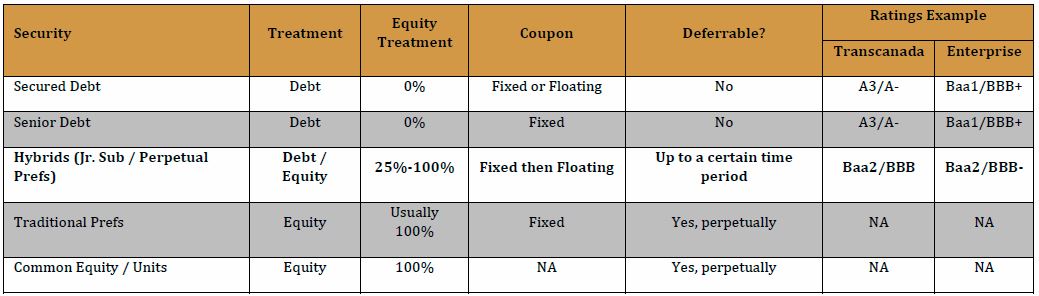
Hybrids are attractive to issuers since rating agencies assign them partial equity treatment, allowing companies to issue debt-like securities without jeopardizing their credit ratings.  Hybrids provide investors with a better yield than the relevant issuer’s senior debt and a higher position in the capital structure compared to the equity along with positive correlation to interest rates (post coupon reset to a floating structure). 
Click image to enlarge.
Hybrid Securities Overview
Hybrids have historically been utilized by Financial/Insurance and Banking issuers to lower their cost of capital and comply with the requirements of Basel 3 guidelines but have gained prominence amongst other sectors in recent years.
Click image to enlarge.
Since 2011, midstream companies have raised $126 billion in equity through unit issuance while raising $40 billion through hybrid issuance through 280 equity deals vs. 87 hybrid deals. However, the issuance of hybrids picked up significantly in 2016/2017 (52 equity deals vs. 44 hybrid deals) as the equity performance of midstream companies remained volatile. 
Click image to enlarge.
Cost of Capital (MLPs vs. Hybrids)
Since 2011, midstream companies have issued $40  in hybrids with an average cost of capital differential of ~300bps (higher in 2015-2016) compared to equity yield. Given the recent rise in equity cost of capital for midstream companies and leverage concerns, we believe hybrids will continue to be a preferred avenue to raise capital. 
Click image to enlarge.
Pros/Cons of Hybrids
  • Solid Yield Differential: In our study, we found that hybrids are trading at a spread of +179bps (range of ~60bps to ~400bps) to their respective senior note’s yield-to-worst.  In our view, this yield differential is significant given that an investor is not taking duration risk (unlike longer dated bonds) and the ratings differential is minor (1-2 notches below senior notes). 
  • Strong position in the capital structure: Unlike equity units where there is distribution/dividend cut risk, hybrid issuers cannot cut coupons. Hybrids do offer the issuer the option to defer interest for a certain period.  However, in the event the issuer chooses to defer the interest on the hybrids, it is forbidden to pay any distribution/dividends or engage in any dividends.
  • Positive correlation to interest rates: Hybrids have a floating rate component embedded in their coupon structure and usually float at LIBOR plus a fixed spread. Given the rising rate environment, hybrids offer investors an attractive way to earn a decent cash yield and rising correlation to interest rates without stepping out on the duration curve. 
The views expressed do not constitute research, investment advice or trade recommendations and do not necessarily represent the views of all BlackGold Capital Management or TEXPERS.

About the Author
Shalin Patel
Shalin Patel joined BlackGold Capital Management LP in 2010 and is the director of research, overseeing the research efforts of the investment team while covering the Midstream sector. Mr. Patel also serves on the Investment and Risk Management Committees. He has over 9 years of energy high yield, distressed, and equity experience. Prior to BlackGold, he was in graduate school at Tulane University. While at Tulane, he was the Associate Director of Research at Burkenroad Reports, an equity research program at Freeman School of Business. Prior to Tulane, he worked as an equity analyst at Khandwala Integrated Financial Services, a brokerage firm in India. Mr. Patel graduated from Tulane University with a master's degree specializing in Finance and Energy and holds a Bachelor of Science in management concentrating in Information Technology from Gujarat University.